

In-vivo skin measurements
INTRODUCTION
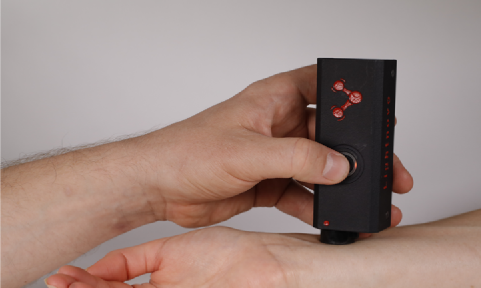
Raman spectroscopy has shown to be a promising technique for different skin diagnostics such as cancer and atopic dermatitis. This technique is non-invasive and can provide several information regarding the molecular composition of the surface of the skin and up to several hundred micrometers in depth.
However in-vivo skin measurements are typically associated with complex Raman instrumentation that requires a deep cooling sensor due to the low Raman cross section of skin, especially at a depth of more than 100µm1,2. Additionally, in-vivo skin measurements require the development of an immersion probe with high numerical aperture NA that can provide a small laser spot size in depth of tissue.
TECHNOLOGY
Raman spectroscopy provides a unique opportunity to study the chemical composition of materials at the microscale. Such capabilities come at the cost of extremely high requirements for instrumentation: lasers with stabilization of wavelength and power, low noise spectroscopic sensors, and a large clear aperture of spectrometer’s optics. Therefore, demanding Raman spectroscopy and microscopy applications usually require high-end, bulky, and costly Raman instrumentation.
Lightnovo ApS found possible solutions to the most critical Raman miniaturization challenges: need for laser temperature and power stabilization, reduction of sensor dark noise, compensation on pixel-to-pixel quantum efficiency (QE) variation, laser optical isolation and achieving high spectral resolution.